Tarot card meaning · Major Arcana V
The Old Door
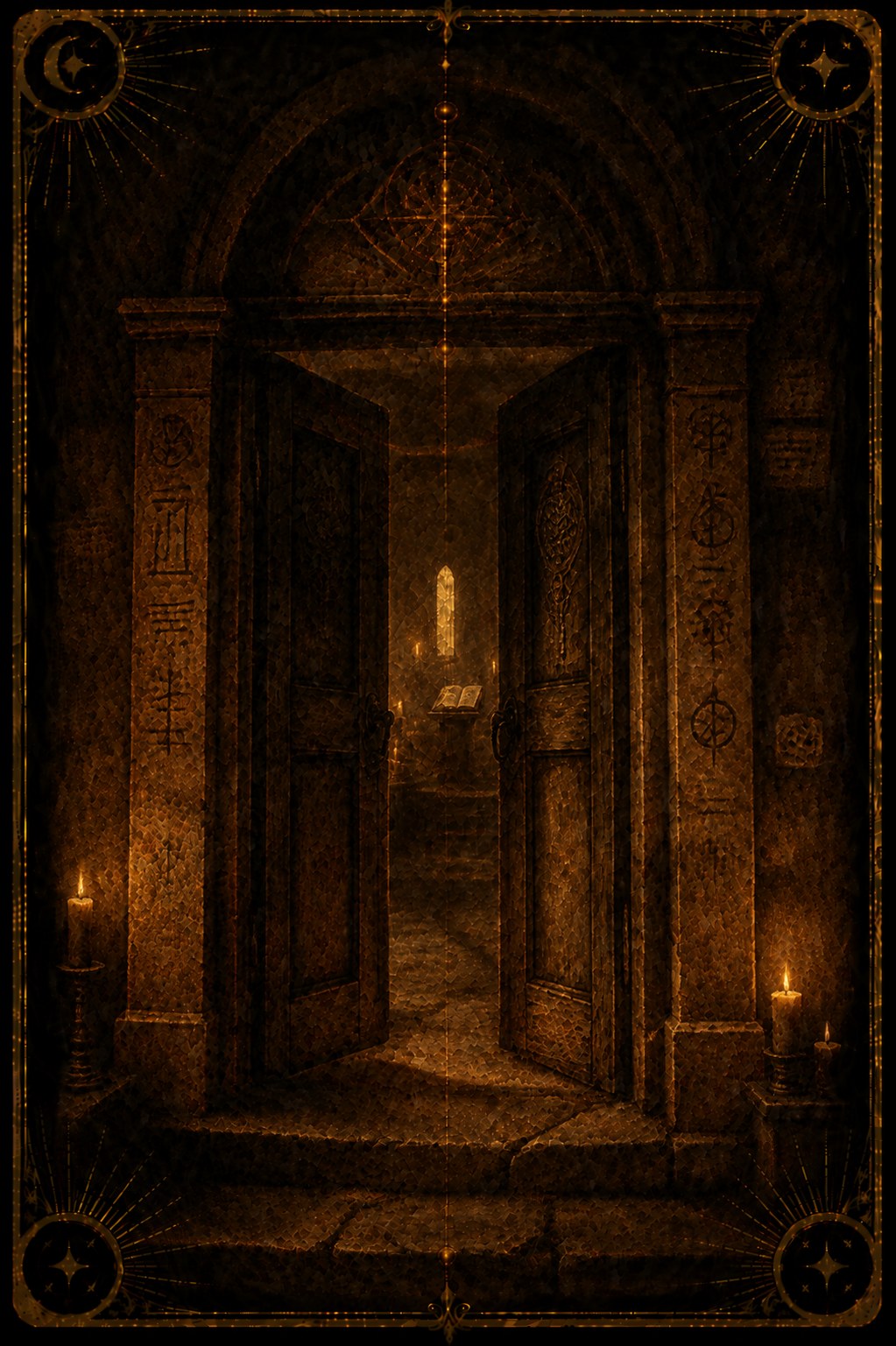
What was handed to you — and whether you pass through it or only stand where you were told.
Also known as : The Hierophant (Major Arcana V) · The Teacher · Le Pape (Tarot de Marseille) · The Tradition · The Inherited Threshold
EnglishEspañolFrançaisDeutsch (en)
Upright and reversed, at a glance
Upright
- ✦Teaching accepted from someone who walked first
- ✦Tradition used as a doorway, not a fence
- ✦Learning the form before breaking it
- ✦Belonging to something older than you
Reversed
- ✦Obedience to a rule nobody can explain
- ✦Rejecting all inheritance to avoid choosing any of it
- ✦A teacher outgrown but still obeyed
- ✦Standing at the threshold for years, calling it respect
Curious how it reads for you? Try a draw with Madam Moira →
Classical tarot meaning: The Hierophant
The fifth card of the Major Arcana is the Hierophant — the keeper of received wisdom, raised hand, two pillars, two keys. Where the High Priestess holds the secret, he holds the curriculum: what a community has agreed is worth passing on.
Traditionally it reads as tradition, mentorship, institutions, and the safety and the cost of an inherited path.
The card in Madam Moira's deck
In Madam Moira's deck it is painted as The Old Door: worn wood in a dark wall, the hinges dulled by many hands, light showing thin and gold at the seams. Others crossed here long before you. That is what makes it both an invitation and a weight.
The painting deliberately shows a door and not a wall. Whatever was handed to you is a passage — but only if you actually go through.
Upright: what it asks of you
Upright, the card favours learning the form. Find the person who has done this already; use the tradition, the method, the practice, the twelve steps somebody wrote before you were in pain. There is no shame in an inherited answer that works.
It also asks what you carry forward on purpose: which parts of where you come from you would choose again.
Reversed: where the inheritance goes wrong
Turned inward, the door becomes a wall. A rule is obeyed with no living reason behind it, or a mentor's voice keeps deciding things long after you outgrew them. There is also the reverse rebellion: discarding every inheritance wholesale, which leaves you starting each lesson from nothing.
The correction is selective: keep what is load-bearing, name what is decoration.
The Old Door in love, work, and the everyday
In love, it points to the family pattern quietly running the household — whose parents' marriage you are re-enacting. In work, it is the card of apprenticeship, of institutions, of doing it the established way while you learn what the way is for.
Day to day, it asks: whose voice was that, and do you still agree with it?
What this card asks
- ✦“Which inherited rule would you choose again on your own?”
- ✦“Whose voice speaks when you say 'that's just how it's done'?”
- ✦“What door have you stood at without walking through?”
Draw a card with Madam Moira and see how The Old Door reads against your own question, or read the guide to the reading first.